Colorado CDL and Trucking Guide
To get a CDL in Colorado, you pass the written knowledge tests at a state driver license office for a commercial learner's permit, hold the permit for 14 days, then pass a three-part skills test with an approved third-party tester. If it is your first Class A or Class B CDL, federal rules also require entry-level driver training (ELDT) from a provider on FMCSA's Training Provider Registry before the skills test.
Last verified: · every fact links to its official source
The official Colorado CDL manual
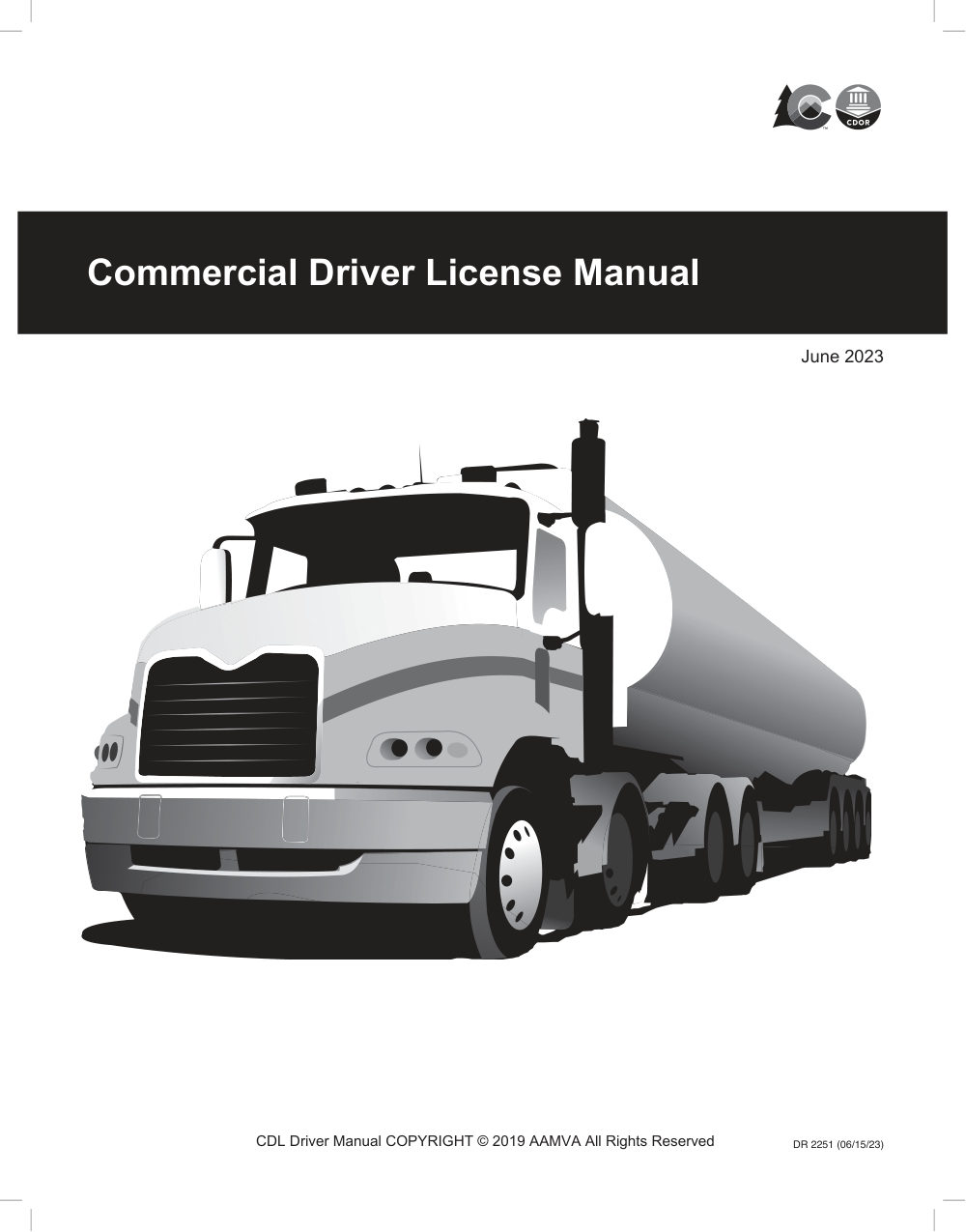
Your permit knowledge tests come from this manual, published by Colorado Department of Revenue, Division of Motor Vehicles. Read it right here on the page, or download the PDF to keep on your phone or computer.
Read the manual hereDownload the PDF
Our copy was downloaded from the state on October 14, 2026. The state's own file is always at its official manual link, and the state CDL page lists the newest edition. Link checked October 4, 2026.
Getting a CDL in Colorado
| Licensing agency | The Division of Motor Vehicles (DMV), part of the Colorado Department of Revenue, issues commercial learner's permits and CDLs. Its CDL Unit is in Lakewood.[1] |
|---|---|
| Official CDL manual | Colorado Commercial Driver License Manual, DR 2251 (PDF), dated June 2023. If that link moves, use the DMV's commercial driver license page or its driver manuals page.[2][1][3] |
| Minimum age | 18 for a Colorado permit or CDL. Drivers 18 through 20 get a "K" restriction that limits them to driving inside Colorado. You must be 21 to drive a commercial vehicle across state lines, and the DMV says 21 for the hazardous materials endorsement.[2][1][4] |
| What you need first | A valid Colorado driver license, proof of lawful presence, your Social Security number, and two proofs of your Colorado home address. The DMV says a REAL ID does not count as proof of lawful presence for a permit or CDL.[1] |
| Knowledge tests | You book a "CDL Written Test" appointment at a state driver license office. The CDL knowledge test is offered in English and Spanish. The hazmat knowledge test is in English only.[1] |
| Wait after the permit | You must hold the permit for 14 calendar days before you can take the skills test.[1] |
| How long the permit lasts | One year, and it cannot be renewed. If it runs out before you get your CDL, you take the written tests again.[1] |
| Skills test | Three parts, taken in this order: vehicle inspection, basic vehicle control and the on-road test. You must pass each part before moving to the next, and the manual says the skills test is given in English only.[2] |
| Where skills tests are given | At approved third-party testing facilities. State driver license offices do not give driving skills tests. After you pass, you go back to a driver license office to get the CDL.[1][3] |
| How long the CDL lasts | Four years from the date it is issued.[1] |
Colorado CDL permit and license fees
These are the fees the Colorado DMV publishes for a commercial learner's permit, the tests and a CDL. Each row says who pays it. We list a fee only where the state names it and gives the amount. Checked October 5, 2026.
| Fee | Amount | Who pays it |
|---|---|---|
| Learner's permit and knowledge tests | ||
| Commercial learner's permitThe DMV's fee table calls it an Instruction Permit, under Commercial Driver's License Fees. | $20.00[5] | A first CDL |
| Commercial learner's permit with the passenger endorsementThe DMV says a driver who already has a CDL and wants to add the P endorsement must pass the passenger written exam and purchase an instruction permit with the endorsement before the skills test. The DMV's fee table lists an Instruction Permit at $20.00 under Commercial Driver's License Fees. If you add S at the same time, the DMV describes one permit with both endorsements. | $20.00[6] | A CDL holder adding an endorsement: with Passenger |
| License | ||
| Commercial driver's license | $35.00[5] | A first CDL |
Not in the table for a first CDL, because we could not confirm the amount from the Colorado DMV:
- The skills test fee, which the third-party tester sets
- The federal HazMat background check
- Any endorsement or knowledge test fees
Not in the table for a driver who already holds a CDL, because we could not confirm the amount from the Colorado DMV:
- All fees for moving up a class, which the DMV does not state for an upgrade
- The fee for the new license after adding an endorsement
- The permit for adding the school bus endorsement when you already have the passenger endorsement
- Any endorsement or knowledge test fees
- The skills test fee, which the third-party tester sets
- The federal HazMat background check
Renewal: The DMV's fee table lists one fee for a Commercial Driver's License, $35.00, and does not list a separate renewal fee.[5]
- A Colorado CDL is valid for 4 years from the date it is issued.[7]
- A commercial learner's permit is valid for one year and cannot be renewed. If you do not get your CDL before it expires, you retake the written tests.[7]
- Under Other Fees, which the DMV says apply to all applicants, a written knowledge retest is $11.50.[5]
- State driver license offices are not conducting driving skills tests.[8]
- The DMV's fee table lists one fee for a commercial driver's license, $35.00. It lists no credit and no different fee for time left on the license you hold now.[5]
Fees change. Confirm your total with the Colorado DMV before you go. The Colorado DMV sets these fees; Red River Valley CDL does not collect them.
Add up your Colorado CDL costs
Getting your permit, your first CDL, adding endorsements, moving up a class or renewing: the CDL cost calculator adds up the the Colorado DMV fees above for your class and endorsements, with a source link on every line.
ELDT in Colorado: what has to be done before you test
Entry-level driver training (ELDT) is a federal rule, so it works the same in Colorado as in every other state. If you are getting a Class A or Class B CDL for the first time, upgrading to a Class A or B, or adding a passenger (P), school bus (S) or hazardous materials (H) endorsement for the first time, you have to complete training with a provider listed on FMCSA's Training Provider Registry (TPR).[10]
The state cannot give you the skills test for a Class A or B CDL or a P or S endorsement, or the knowledge test for the H endorsement, until that training is on record.[11] Theory can be done online: the federal definition of theory instruction includes online training.[12] Except for the HazMat endorsement, the theory and behind-the-wheel parts have to be finished within one year of each other.[13]
Colorado follows the federal rule. The DMV's CDL page lists entry-level driver training as a required step before the skills test, sends you to the federal Training Provider Registry to find a provider, and asks for proof that you finished ELDT when you come in for the license.[1] The DMV's ELDT handout says the training is for anyone applying for a Class A or Class B CDL for the first time, upgrading a license, or adding a passenger, school bus or hazardous materials endorsement.[9]
Truck driving jobs and pay in Colorado
| Drivers employed (May 2025) | 25,350[14] |
|---|---|
| Median pay (May 2025) | $61,500 a year, or $29.57 an hour[14] |
| Average pay (May 2025) | $63,650 a year, or $30.60 an hour[14] |
| Projected jobs, 2024 to 2034 | 29,890 in 2024, growing to 33,420 in 2034 (up 11.8%)[15] |
| Projected openings each year, 2024 to 2034 | About 3,550 a year, counting new jobs and replacements[15] |
The wage figures are from the federal Occupational Employment and Wage Statistics survey. The projections come from Colorado's own long-term forecast, published through Projections Central. The two sources give different job totals.
Truck rules on Colorado roads
Size and weight limits
| Width | 8 feet 6 inches, including the load. The 2024 edition of the statutes does not count required mirrors and clearance lights.[16][17] |
|---|---|
| Height | 14 feet 6 inches. Under the 2024 edition of the statutes, the limit applies loaded or empty, CDOT designates the structures with less clearance than that, and you may not drive under one your vehicle will not clear.[16][17] |
| Single vehicle length | 45 feet. The 2024 edition of the statutes counts the front and rear bumpers.[16][17] |
| Semitrailer length | 57 feet 4 inches. CDOT's guidebook says a tractor and trailer has no overall length limit as long as the trailer is no longer than that.[16][17] |
| Overall combination length | Other combinations are limited to 70 feet and no more than four units. CDOT's guidebook and the 2024 edition of the statutes also cap a "laden truck tractor-semitrailer" combination at 75 feet, stinger-steered auto and boat transporters at 80 feet, and saddlemount combinations at 97 feet.[16][17] |
| Overhang | A load may stick out no more than 4 feet in front and 10 feet to the rear without a permit.[16][17] |
| Gross weight, Interstates | 80,000 pounds at most, set by the federal bridge formula[16][17] |
| Gross weight, other highways | 85,000 pounds at most[16][17] |
| Single axle | 20,000 pounds[16][17] |
| Tandem axle | 36,000 pounds on Interstates and 40,000 pounds on highways that are not Interstates[16][17] |
| Alternative fuel trucks | Under the 2024 edition of the statutes, the gross weight limits go up by as much as 2,000 pounds for a vehicle that has an alternative fuel system and runs on alternative fuel.[16] |
The width, height, length, overhang, gross weight and axle figures are in CDOT's August 2026 guidebook. Details marked 2024 come only from the 2024 edition of the Colorado Revised Statutes posted by the General Assembly, so check them against current law.
Longer combination vehicles
Colorado is on the federal list of states with grandfathered longer combinations. It allows three kinds under an annual permit: a tractor with two trailing units up to 111 feet of cargo-carrying length, a tractor with three trailing units up to 115½ feet, and a truck-trailer up to 78 feet. The doubles and triples can gross up to 110,000 pounds. They must have at least six axles and no more than nine, and the shorter trailer goes in back.[18]
They may run only on Interstate 25 from New Mexico to Wyoming, Interstate 70 from Utah to Exit 90 at Rifle and from Exit 259 at Golden to Kansas, Interstate 76, Interstate 225 and Interstate 270. The list does not include I-70 between Exit 90 and Exit 259. A tractor with two trailing units, where at least one is over 28½ feet, is kept off listed Interstate segments in Colorado Springs, Denver and Pueblo from 6 to 9 a.m. and 3 to 6 p.m., Monday through Friday. You may leave the Interstate only for food, fuel, repairs and rest, or to reach an approved facility within 10 miles.[18]
Truck speed limits
The 2024 edition of Colorado's speed law makes 65 mph lawful on Interstates, freeways and expressways and 55 mph on other open highways unless a sign says otherwise, and says no speed limit in the state can be posted above 75 mph. That 2024 edition also lists 40 mph on open mountain highways and 20 mph on narrow, winding mountain highways.[16]
CDOT's guidebook says that as of January 1, 2024, speeding fines and surcharges are doubled for commercial vehicles on signed downhill grades of 5% or more, and that as of August 7, 2024, fines and surcharges for speeding on Interstate 70 in Glenwood Canyon went up when a speed limit enforcement zone was set up there. Commercial vehicles are also barred from the far left lane on six stretches of I-70 between Glenwood Canyon and Floyd Hill, except to pass a vehicle going under the speed limit. CDOT lists them as mileposts 115.5 to 131, 169.5 to 173, 180 to 190.5, 205.5 to 221, 224 to 228.5 and 243 to 247.[17]
Winter restrictions and chains
Colorado has two chain rules for commercial vehicles. CDOT applies them to vehicles with a gross vehicle or combination weight rating of 16,001 pounds or more used in commerce, and to vehicles that carry 16 or more passengers.[19][16]
- Must carry, September 1 through May 31: you must have chains or approved alternative traction devices on board on Interstate 70 west of milepost 259 (Morrison to the Utah line), Colorado 9 from milepost 63 to 97 (Frisco to Fairplay), US 40 west of milepost 256 (Empire), US 50 west of milepost 225 (Salida), US 160 west of milepost 304 (Walsenburg), US 285 west of milepost 250 (Morrison), and US 550 from milepost 0 to 130.[19][16]
- Chain law in effect: on any state, US or Interstate highway where CDOT has called the commercial vehicle chain law, you must have chains or approved devices on at least four drive tires, or on all of them if you have fewer than four. Buses need them on two drive tires. Trailers do not need chains.[19][16]
- What counts: For trucks that must chain four drive tires, CDOT's fact sheet lists four tire chains, four AutoSocks, automatic chains or sanders. Single drive axle combinations may not use cables.[19]
- Right lane: while the chain law is active, commercial vehicles stay in the right lane unless they must pass a stalled or slower vehicle to keep traction.[20]
- Placarded loads: hazmat trucks still have to chain up, but they may pass the chain-up signs and put chains on at a safe spot off the road where the pavement is covered with snow or ice.[20]
| Not carrying chains, September through May | $100 plus a $32 surcharge[19] |
|---|---|
| Not chaining up when the chain law is in effect | Up to $500 plus a $78 surcharge[19] |
| Blocking the road because you did not chain up | $1,000 plus a $156 surcharge[19] |
CDOT announces the chain law on message signs, COtrip.org, and phone, text and email alerts, by milepost and exit number. Chains stay on until CDOT lifts the law the same way. The fact sheet maps the chain-up stations.
Mountain grades and runaway truck ramps
CDOT lists five runaway truck ramps on Interstate 70: westbound at mileposts 182 (Upper Vail), 186 (Lower Vail), 209 (Lower Straight Creek) and 212 (Upper Straight Creek), and eastbound at milepost 257 (Mt. Vernon Canyon). Others are on Colorado 141 eastbound at milepost 18, US 550 southbound at milepost 52, US 40 westbound at milepost 142, US 160 westbound at mileposts 160 and 162, and US 50 westbound at milepost 194 and eastbound at milepost 204.[17]
CDOT says there is no fee, penalty or fine for using a ramp, though you may have to pay for the tow. Do not take a highway exit in place of a ramp. Get in the right lane, go in straight, let the truck stop on its own and call 911.[21][17] The guidebook names I-70 westbound just east of Silverthorne near Exit 205 and eastbound near Georgetown at Exit 228 as the main hot-brake areas.[17]
CDOT, the Colorado State Patrol and Drivewyze also offer free in-cab alerts through your ELD for the Eisenhower-Johnson Memorial Tunnel, steep grades, weather closures and non-truck routes such as Independence Pass. Sign up on CDOT's in-cab alerts for commercial vehicles page.[22]
Seasonal and posted roads
The 2024 edition of the Colorado statutes lets cities and counties close a road or lower its weight limit for up to 90 days in a calendar year when weather or the condition of the road would lead to serious damage, and they must put up signs showing the weight allowed. That 2024 edition gives CDOT the same power over weight limits on state highways, and its limits take effect once the signs are up.[16] CDOT keeps its bridge weight limits, low clearances and current restrictions on the maps at its freight and permitting site.[23]
Idling
The 2024 edition of the Colorado statutes limits idling to 5 minutes in any 60-minute period for commercial diesel vehicles with a gross vehicle weight rating over 14,000 pounds. The limit does not apply when you idle to heat or cool a sleeper berth during a rest period at a safety rest area, a fleet terminal, a commercial truck stop or a state-designated rest location, or anywhere you may legally park that is at least 1,000 feet from housing, a school, a daycare, a hospital, a senior center or an outpatient clinic. You may idle up to 20 minutes in 60 when it is colder than 10 degrees. Idling in traffic, for repairs, for inspections and to run power take-off equipment is also exempt.[16]
In the 2024 edition of the statutes, the fine is up to $150 for a first offense and up to $500 after that, plus a $20 surcharge. Since August 7, 2024, local governments may pass idling rules that are at least as strict as the state standard, so check local rules too. All of these idling figures are from the 2024 edition, so check them against current law.[16]
HazMat routes and tunnels
The big one is the Eisenhower-Johnson Memorial Tunnel on Interstate 70. Trucks carrying hazardous materials are not allowed through it. They go over Loveland Pass on US 6 instead, leaving I-70 at Exit 216 westbound or Exit 205 eastbound. When Loveland Pass is closed for weather, hazmat trucks stage at the tunnel and attendants stop other traffic and escort them through at the top of the hour. CDOT says explosives and highly corrosive loads are never allowed in the tunnel.[17]
- Stay on designated routes: a truck with a placarded load generally has to stay on Colorado's designated hazardous materials routes and take the shortest direct path to reach one. Exceptions cover local pickup and delivery, service, closures and unsafe conditions. The Colorado State Patrol is the agency that designates the routes.[17][24]
- State permit: Colorado requires its own hazardous materials permit for a vehicle carrying a placardable amount. It is issued through CDOT's COOPR system.[17][24]
- Federal registry: FMCSA's route registry for Colorado, dated April 2024, has two restricted entries that bar Class 7 radioactive materials from Interstate 70 between Interstate 25 and State Highway 2, and from Interstate 70 between the Utah line and US 40. Read the registry itself for the full list.[25]
- Denver area: CDOT says the route from the DJ Basin area in Weld and Adams counties to Commerce City is US 85, Interstate 76 and Interstate 270, and that Highway 2 is not a hazmat route.[17] E-470 has been a designated hazardous materials route since April 1, 2022.[26]
Check the FMCSA hazardous materials route registry by state and CDOT's hazardous and nuclear materials routing maps before you route a load.
Tolls and transponders
E-470 runs 47 miles around the east side of the Denver area, from Interstate 25 in the south, past Denver International Airport, to Interstate 25 in the north. It is all-electronic. No cash is taken and you do not stop.[27][28]
Colorado's transponder system is ExpressToll. With an account you get a transponder and pay from a prepaid balance, and E-470 says account holders save more than 35% on its tolls. Without an account, cameras read your plate and a License Plate Toll statement is mailed to the registered owner at a higher rate.[29][30] Trucks pay by the axle, and E-470 gives a discount to vehicles with three or more axles that have an ExpressToll transponder, with the lowest rates between 9 a.m. and noon.[26][31]
CDOT also runs tolled Express Lanes next to the free lanes on US 36, Interstate 25, Interstate 70 and C-470.[27] See the E-470 toll rates by axle count.
Fuel tax (IFTA)
| IFTA diesel rate, 4th quarter 2026 | $0.335 per gallon[32] |
|---|---|
| Who handles it | The Fuel Tax Unit of the Colorado Department of Revenue issues IFTA licenses and decals to carriers based in Colorado. Carriers based in Colorado that never leave the state do not qualify for IFTA.[33][34] |
| License and decals | The license is good for the calendar year and expires December 31. Carry a copy in each truck, and put one decal on each side of the cab in the lower rear corner.[33][35] |
| No license or decals | You may have to buy a trip permit. Colorado says carriers can get one at any Colorado Port of Entry.[33] |
IFTA rates can change every quarter. The 4th quarter 2026 matrix was marked not final until December 4, 2026 when this page was checked.
Oversize and overweight permits
CDOT's Office of Freight Mobility and Safety issues oversize and overweight permits through its online system, the Colorado Oversize Overweight Permitting and Routing system (COOPR). You can set up an account at any hour, and many permits issue themselves without waiting for a permit technician. You must buy the permit before you enter the state or move the load. The permit office number is 303-757-9539. Start at CDOT's permitting information page or go to the COOPR permit system.[17][36]
Permitted loads have a winter curfew on Interstate 70 between West Vail (Exit 173) and Morrison (Exit 259). From December 1 to March 31, westbound travel is not allowed from 3 to 8 p.m. on Fridays or from 7 a.m. to noon on Saturdays and Sundays, and eastbound travel is not allowed from 3 to 9 p.m. on Saturdays and Sundays. The fact sheet lists an exception for overweight loads of no more than 110,000 pounds that can hold set minimum speeds.[19] E-470 needs its own oversize or overweight permit.[28]
Truck parking
CDOT's chain-up and brake-check stations are paved and lit, and the guidebook says they may include marked 30-minute parking spots. The guidebook calls them designated chain-up and brake-check stations.[17] CDOT's Mountain Rules program also includes restriping the eastbound exit ramp at the Genesee Park interchange into a short-term truck parking area for cooling brakes before the last descent into the Golden area.[37]
For rest areas, truck stops, chain stations and closures, use the COtrip traveler information map. CDOT says its Trucker Mode adds route planning options for commercial drivers.[17]
Weigh station bypass
In Colorado every weigh station is a Port of Entry, run by the Colorado State Patrol. There are nine fixed ports on the main routes in and out of the state, plus ten mobile units. You must clear a port if your vehicle is over 16,000 pounds empty, has an apportioned or gross vehicle weight plate, has a gross vehicle weight rating over 26,000 pounds, or carries a placardable amount of hazardous materials without a Colorado annual hazmat permit. The ports take credit cards and checks only.[17]
CDOT's guidebook says Colorado partners with private electronic clearance services, and it names PrePass, Fleetworthy and Drivewyze. Enrolled trucks that pass the screening get a signal to bypass, and the rest must pull in. A truck with an oversize or overweight permit that is routed through a port must stop. The State Patrol can also issue a Special Revocable Permit that lets a carrier with a steady route within five miles of the same port skip it.[17]
Help paying for CDL training in Colorado
Colorado keeps a statewide Eligible Training Provider List (ETPL) that shows which training programs can be paid for with Workforce Innovation and Opportunity Act (WIOA) funds. The Colorado Workforce Development Council moved it to a new website on July 1, 2026, and says some programs were still being moved over or were waiting on required reporting.[38]
The council's Colorado Eligible Training Provider List page links to the list and explains the changeover.[38]
To ask about funding, contact your local Colorado Workforce Center. The Department of Labor and Employment says its career counselors can connect job seekers with training and any available funding. Use its Colorado Workforce Center locations page to find yours.[39] Ask three things: whether you qualify for WIOA training funds, which CDL programs on the list they will pay for, and what paperwork they need before you enroll. Get the answer before you pay a school.
Veterans and military drivers in Colorado
Colorado military CDL skills test waiver (Vets-2-Trucks)
Federal rules let a state waive the CDL skills test for drivers with military commercial vehicle experience.[40] Colorado does this through its Vets-2-Trucks program. It is for Colorado residents who are serving now, are close to discharge, or were discharged within the last year. You need at least two years of driving a military vehicle equal to a commercial motor vehicle right before discharge, and the waiver covers only the same class of vehicle. It waives the driving skills test. You still have to pass the written tests.[1][41]
You apply with Form DR 2742, the Application for Military CDL Skills Test Waiver (PDF). Your commanding officer fills out and signs the second page. You also complete the DMV's 10-year license certification, attach a copy of your military license or military driving record, and send it all to the DMV's CDL Unit, by email if you can. Once you qualify, you make an appointment at a full-service driver license office, pass the written tests, show your DOT medical card and buy the CDL.[41]
GI Bill and VR&E
If you plan to use VA education benefits, check the school first. The VA's GI Bill Comparison Tool lets you look up schools and training programs.[42] Veterans with a service-connected disability can also ask about Veteran Readiness and Employment (Chapter 31).[43] Ask any school whether it is approved for VA benefits before you enroll.
Behind-the-wheel training in Colorado
For a CDL, passenger or school bus endorsement, theory is only half of ELDT. The range and road training has to be done in a truck or bus with a behind-the-wheel provider that is also listed on the Training Provider Registry.[10] The HazMat endorsement is theory only.[44]
To find one near you, use the FMCSA Training Provider Registry provider search: pick the license or endorsement, choose Behind-the-Wheel, and enter your location.[44] You can take theory from one provider and behind-the-wheel from another.
Behind-the-wheel training in Glyndon, Minnesota
Red River Valley CDL Training is just east of Moorhead and Fargo. Colorado students can train with us here in our truck, or Carl can come to Colorado and train you in your own truck, with travel fees. Your permit, tests and CDL come from the Colorado DMV.
Check your Training Provider Registry record
When you finish a course, your training provider has until midnight of the second business day to send your completion to the Training Provider Registry.[45]
You can look it up yourself with FMCSA's Check Your Record tool on the Training Provider Registry. Enter your license or permit number and state, your date of birth, and your first and last name exactly as they appear on your license or permit.[46]
Colorado CDL questions
How old do you have to be to get a CDL in Colorado?
You can get a Colorado commercial learner's permit or CDL at 18. Drivers 18 through 20 get a K restriction that limits them to driving inside Colorado. You have to be 21 to drive a commercial vehicle across state lines, and Colorado's DMV says 21 for the hazardous materials endorsement.[2][1][4]
Where do I take the CDL skills test in Colorado?
With an approved third-party tester. State driver license offices give the written knowledge tests but not driving skills tests. You must hold your permit for 14 calendar days first, and after you pass you go back to a driver license office to get the CDL.[1][3]
Do trucks have to carry chains in Colorado?
Yes, from September 1 through May 31 on the listed mountain corridors, including Interstate 70 from Morrison to the Utah line and parts of Colorado 9, US 40, US 50, US 160, US 285 and US 550. It applies to commercial vehicles rated 16,001 pounds or more. CDOT lists the fine for not carrying chains as $100 plus a $32 surcharge.[19][16]
Can hazmat trucks go through the Eisenhower Tunnel on I-70?
No. Trucks carrying hazardous materials go over Loveland Pass on US 6, using Exit 216 westbound or Exit 205 eastbound. When Loveland Pass is closed for weather, hazmat trucks stage at the tunnel and are escorted through at the top of the hour. CDOT says explosives and highly corrosive loads are never allowed in the tunnel.[17]
How long can a truck idle in Colorado?
The 2024 edition of the Colorado statutes sets the limit at five minutes in any 60-minute period for commercial diesel vehicles rated over 14,000 pounds. Heating or cooling a sleeper berth during a rest period is exempt at rest areas, truck stops and terminals, or where you are legally parked at least 1,000 feet from homes, schools and hospitals. In that 2024 edition the fine is up to $150 for a first offense, and local rules may be at least as strict.[16]
Other state guides
Researching another state? ELDT.Courses keeps sourced guides for all 50 states and DC at eldt.courses/states.
Where these facts come from
Every fact on this page comes from an official source that was opened and read on the date shown. Click a source to read it yourself. Rules, fees, rates and wages change, so check the source before you rely on a number.
- Colorado Department of Revenue, Division of Motor Vehicles. Commercial Driver License General Information. Checked October 4, 2026.
- Colorado Department of Revenue, Division of Motor Vehicles. Colorado Commercial Driver License Manual, DR 2251 (06/15/23). Checked October 4, 2026.
- Colorado Department of Revenue, Division of Motor Vehicles. Driver Education (manuals and handbooks). Checked October 4, 2026.
- eCFR. 49 CFR 391.11, General qualifications of drivers. Checked October 4, 2026.
- Colorado Department of Revenue, Division of Motor Vehicles. State DMV fees. Checked October 5, 2026.
- Colorado Department of Revenue, Division of Motor Vehicles. CDL Endorsements and Restrictions. Checked October 5, 2026.
- Colorado Department of Revenue, Division of Motor Vehicles. Commercial Driver License General Information. Checked October 5, 2026.
- Colorado Department of Revenue, Division of Motor Vehicles. Driver Education. Checked October 5, 2026.
- Colorado Department of Revenue, Division of Motor Vehicles. Entry Level Driver Training (ELDT) postcard. Checked October 4, 2026.
- eCFR. 49 CFR 380.609, General entry-level driver training requirements. Checked October 4, 2026.
- eCFR. 49 CFR 383.73, State procedures. Checked October 4, 2026.
- eCFR. 49 CFR 380.605, Definitions (theory instruction). Checked October 4, 2026.
- eCFR. 49 CFR 380.603, Applicability (entry-level driver training). Checked October 4, 2026.
- U.S. Bureau of Labor Statistics. Occupational Employment and Wage Statistics, Colorado, May 2025. Checked October 4, 2026.
- Projections Central (Projections Managing Partnership). Long-Term Occupational Projections (2024-2034). Checked October 4, 2026.
- Colorado General Assembly, Office of Legislative Legal Services. Colorado Revised Statutes 2024, Title 42, Vehicles and Traffic (sections 42-4-106, 42-4-502 to 42-4-508, 42-4-1101 and 42-14-102 to 42-14-106). Checked October 4, 2026.
- Colorado Department of Transportation, Office of Freight Mobility and Safety. Colorado Commercial Motor Vehicle Regulatory Guidebook (August 2026). Checked October 4, 2026.
- eCFR. 23 CFR Part 658, Truck size and weight, route designations (including Appendix C). Checked October 4, 2026.
- Colorado Department of Transportation, Office of Freight Mobility and Safety. Colorado's Must Carry Law and CMV Chain Law fact sheet (August 2026). Checked October 4, 2026.
- Colorado Department of Transportation, Freight and Permitting. Chain Up Tips and Resources. Checked October 4, 2026.
- Colorado Department of Transportation, Freight and Permitting. Hot Brakes: Tips and Resources. Checked October 4, 2026.
- Colorado Department of Transportation, Freight and Permitting. Free In-Cab Alerts for Commercial Motor Vehicles. Checked October 4, 2026.
- Colorado Department of Transportation, Freight and Permitting. Freight and Permitting home page (Must Carry season, guidebook, OSOW restrictions map). Checked October 4, 2026.
- Colorado Department of Transportation, Freight and Permitting. Hazardous Materials Routing. Checked October 4, 2026.
- FMCSA. National Hazardous Materials Route Registry: Colorado (April 2024). Checked October 4, 2026.
- E470 Public Highway Authority. Commercial Vehicles. Checked October 4, 2026.
- E470 Public Highway Authority. Partner Roads. Checked October 4, 2026.
- E470 Public Highway Authority. Frequently Asked Questions. Checked October 4, 2026.
- E470 Public Highway Authority. ExpressToll. Checked October 4, 2026.
- E470 Public Highway Authority. License Plate Toll. Checked October 4, 2026.
- E470 Public Highway Authority. Toll Rates. Checked October 4, 2026.
- IFTA, Inc.. IFTA Tax Matrix, 4th Quarter 2026 Fuel Tax Rates. Checked October 4, 2026.
- Colorado Department of Revenue, Taxation Division. International Fuel Tax Agreement (IFTA): Application Process. Checked October 4, 2026.
- Colorado Department of Revenue, Taxation Division. IFTA Colorado Base Jurisdiction Qualifications. Checked October 4, 2026.
- Colorado Department of Revenue, Taxation Division. International Fuel Tax Agreement: Decals. Checked October 4, 2026.
- Colorado Department of Transportation, Freight and Permitting. Permitting Information. Checked October 4, 2026.
- Colorado Department of Transportation, Freight and Permitting. The Mountain Rules. Checked October 4, 2026.
- Colorado Workforce Development Council. Colorado's Eligible Training Provider List. Checked October 4, 2026.
- Colorado Department of Labor and Employment. Workforce Centers. Checked October 4, 2026.
- eCFR. 49 CFR 383.77, Substitute for knowledge and driving skills tests for drivers with military CMV experience. Checked October 4, 2026.
- Colorado Department of Revenue, Division of Motor Vehicles. Application for Military CDL Skills Test Waiver, DR 2742 (03/22/22), Vets-2-Trucks Program. Checked October 4, 2026.
- U.S. Department of Veterans Affairs. GI Bill Comparison Tool. Checked October 4, 2026.
- U.S. Department of Veterans Affairs. Veteran Readiness and Employment (Chapter 31). Checked October 4, 2026.
- FMCSA. Training Provider Registry: Find a Provider. Checked October 4, 2026.
- eCFR. 49 CFR 380.717, Training certification. Checked October 4, 2026.
- FMCSA. Training Provider Registry: Check Your Record. Checked October 4, 2026.
Last verified October 4, 2026. General information, not legal advice. State research by ELDT.Courses.